Does Diffusion Actually Capture Multi-Modal Behavior? Re-Running a Myth-Buster’s Tests
I also wrote this up as a thread on X — read it here.
One of the reasons GCPs (generative control policies, like flow and diffusion models) were considered better than RCPs (regression control policies) at task success is that they show multi-modal behavior: when the demonstrations contain several valid actions at the same situation, a generative model is theoretically capable of learning that full distribution, while regression averages the choices into a useless in-between action. However, Much Ado About Noising (Pan et al.) suggests this myth is busted, and provides evidence that GCPs in practice also collapse to a single mode — the flow policies they test behave essentially unimodally on the standard benchmarks — hence multi-modality is not the reason they win. In this blog post we perform the same evaluation, but on diffusion rather than flow, to check whether diffusion policies also collapse to a single mode, or whether there is a change in task success and multi-modality.
Setup
We keep everything the same as the paper’s evaluation scheme and change only the model under test: the same U-Net architecture, the same data and training recipe (400k steps, state observations), trained once with the DDPM diffusion objective and once with flow matching — only the training target equation differs. Every evaluation below is run identically on both.
How Pan et al. evaluate a learned policy’s multi-modality — three methods:
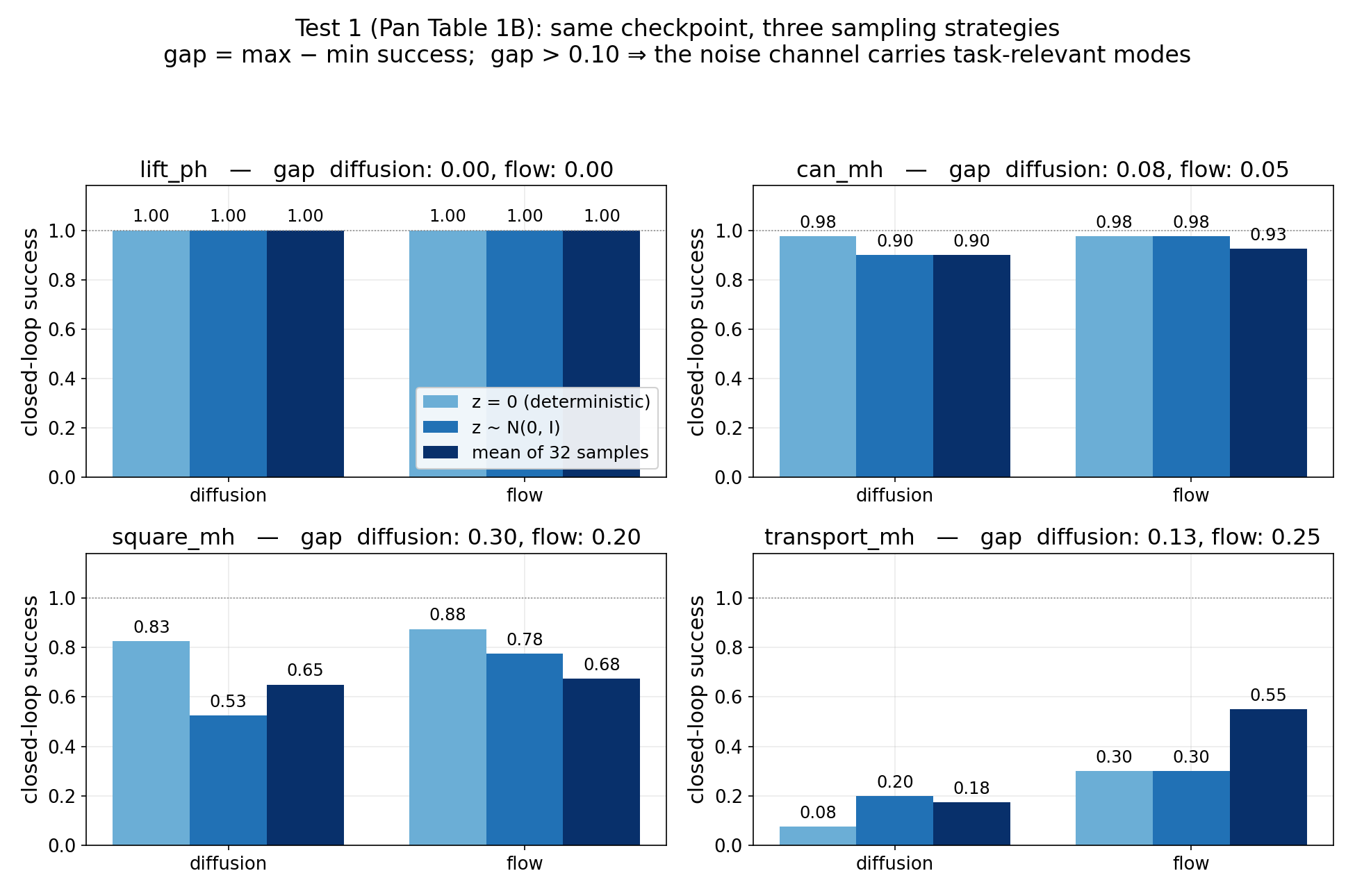
- Sampling-strategy test. Roll out the same trained checkpoint three ways: noise frozen at zero, noise sampled randomly, and the average of many sampled actions. If the policy truly holds several modes, averaging blends them into an invalid action and success should drop; if success barely changes (their largest gap was 0.04), the noise channel carries no real modes.
- Return-colored sample plot. At an ambiguous state, sample many action chunks, embed them in 2D, and color each by its Monte-Carlo return (did continuing from this action succeed?). A multi-modal policy shows several separated clusters that are all high-return. They found none.
- Deterministic-expert control. Retrain on demonstrations from a scripted, deterministic expert (no multi-modality in the data at all) — if multi-modality explained the GCP advantage, it should vanish there. It didn’t. (We don’t re-run this one; our near-unimodal control dataset plays the same role.)
First: is the data itself multi-modal?
A policy can only learn multi-modal behavior if the demonstration data is multi-modal in the first place — this is the paper’s own caveat about its benchmarks. So before evaluating any policy, we check the data. We use the RoboMimic multi-human datasets (can, square, transport — six different operators demonstrating each task) plus lift from a single proficient expert as the control.
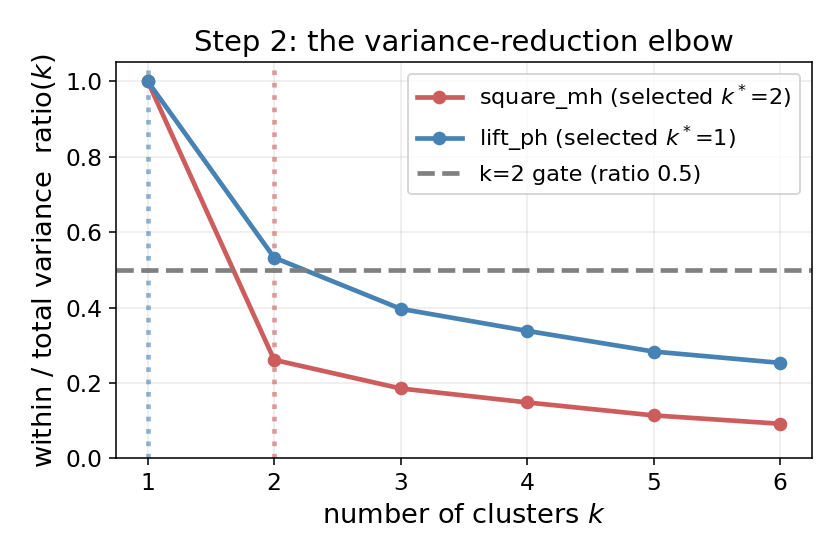
The test: for each state, collect the K = 32 most similar states across all demonstrations and gather the action chunks that were actually taken there. Then run k-means on those actions for k = 1, 2, 3, … and watch how much of the action variance each extra cluster removes. One blob of actions barely splits — the variance ratio stays near 1. Two (or three) genuinely different behaviors split cleanly — the ratio drops sharply, then flattens. The elbow of that curve is the number of modes at that state; a state is multi-modal if it has 2 or more.
The variance-drop curve at one state of each kind — the multi-human state has a sharp elbow at k = 2 (two real modes), the control state has none:
Aggregating over 5000 states per dataset: 45–66% of states in the multi-human datasets are multi-modal, versus 28% in the control — and a quarter of the multi-modal states in the hardest sets carry three modes:
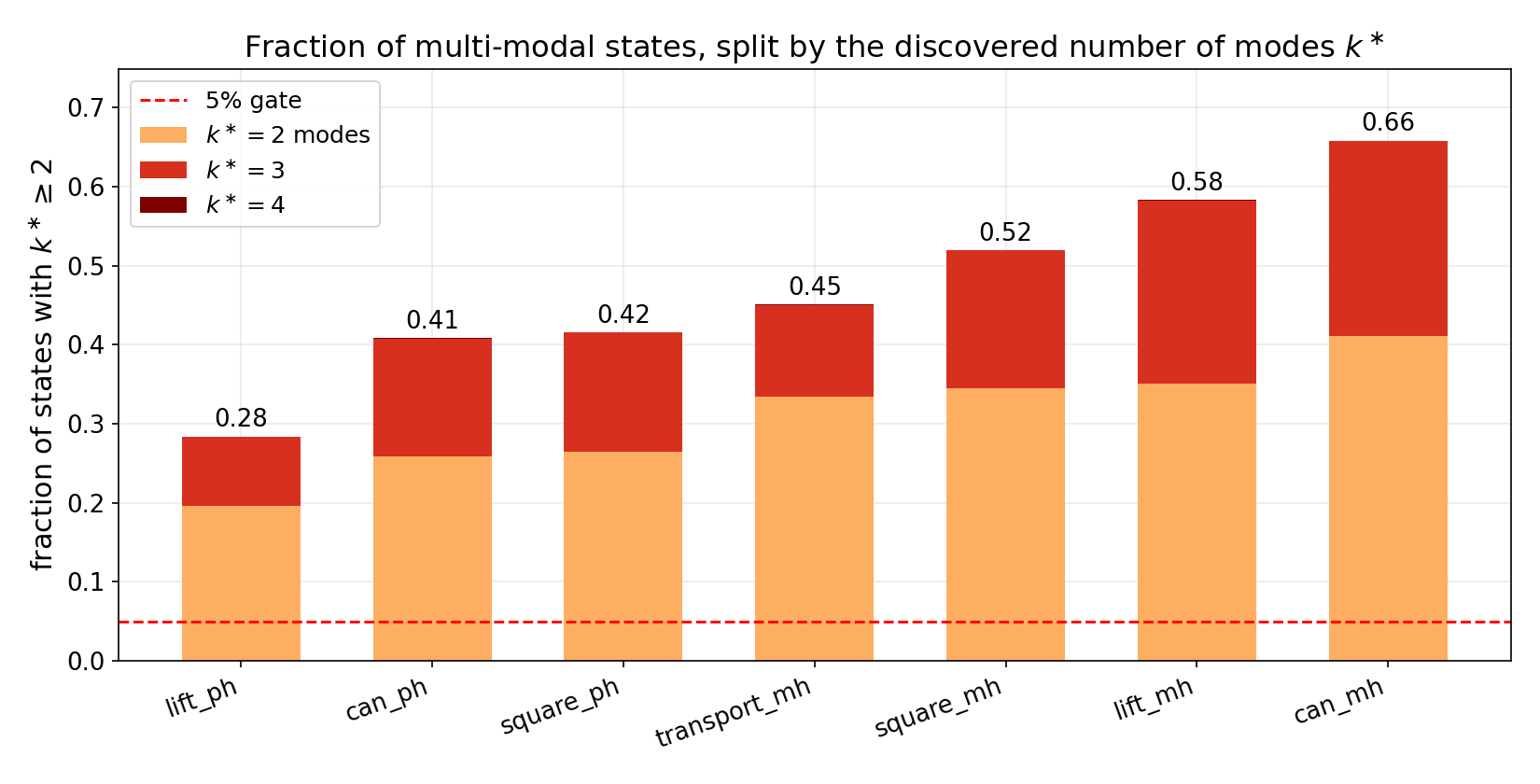
So the modes are really in the data, and any collapse we see next is the policy’s doing.
Results: the policies
Test 1 — sampling strategies. On the control task the gap is 0.00, reproducing the paper’s null exactly. On the multi-human data the invariance breaks for both families: averaging or freezing the noise changes success by up to 0.30 (diffusion) / 0.20 (flow) on square. Once the data has modes, the noise channel carries them.
Test 2 — return-colored samples. Distinct high-return modes do appear. On square, diffusion’s 48 samples concentrate onto a few clearly separated actions — two distinct successful behaviors — while flow’s 48 samples are near-copies of a single action (note the axis scales: flow’s whole cloud spans ~100× less). On transport, both families show modes.
Diffusion on square — two modes | Flow on square — one mode |
|---|---|
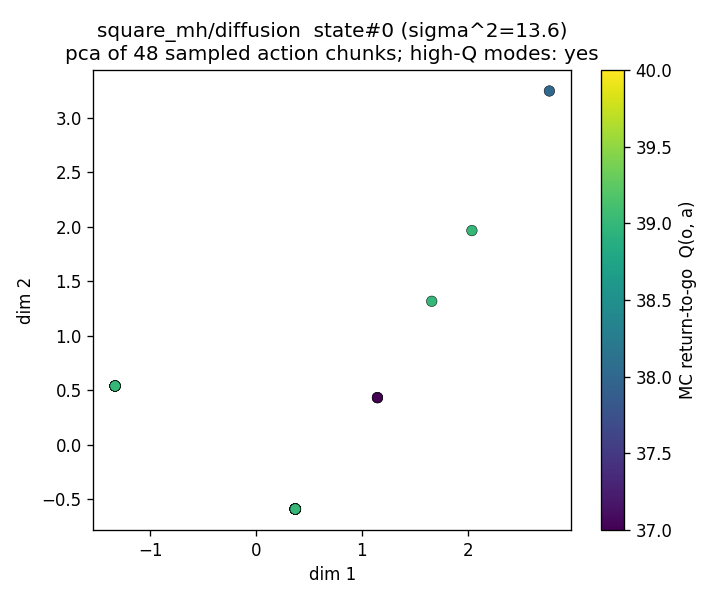 | 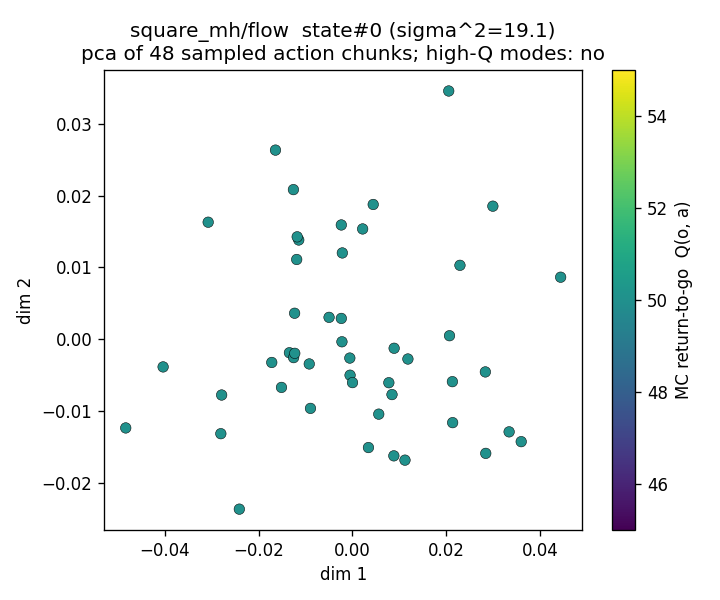 |
So: does diffusion collapse like flow? Not here — and flow itself doesn’t fully collapse on this data either. But the extra mode diffusion captures buys nothing: on square the two families tie on success (0.90 each), and on the hardest task (transport) flow wins (0.55 vs 0.30) even though both show modes.
Takeaway
- Pan et al.’s null reproduces perfectly on low-multimodality data — it is a property of their datasets, not of generative policies. Given genuinely multi-modal demonstrations, both diffusion and flow visibly capture modes.
- Their broader conclusion survives and sharpens: even where diffusion captures a mode that flow drops, it does not translate into better task success. The choice of generative objective still doesn’t seem to be what matters.
Caveats: single seed, 40 evaluation episodes per cell, state-based observations. Data: the public RoboMimic multi-human suite (HF mirror).